Why Didn’t God Create Humanity Perfect?
Why Didn’t God Create Humanity Already Perfected?
If God is all-powerful, why didn’t God create humanity in an already perfected state? Christ’s Bride is clothed in righteousness and free from sin, right? Ephesians 5:25-27 establishes that well:
“Husbands, love your wives, just as Christ loved the church and gave himself up for her to make her holy, cleansing her by the washing with water through the word, and to present her to himself as a radiant church, without stain or wrinkle or any other blemish, but holy and blameless.”
So why can’t we just skip all the nasty stuff up until Revelation 21, and start with the Church already established in a perfected state, out of the box? If we start out perfected, then suffering will be abolished.
Right?
Not so fast.
First we must establish such a thing is possible in the first place. And I’m not granting it. And the reader can say, wait a minute. All things are possible for God. It’s all over the Bible. Yes, it is. Matthew 19:26 and others are hard to deny. But we need to understand fluidity of truth is a thing. 2,000 years ago, apologetics didn’t have to defend against arguments that 1+1=4. Okay, they did, but it’s a crazy common problem now. If I were Jesus today (disclaimer for silly people: I’m not) I would say sure, all logically possible things are possible for God. 2,000 years ago, the Jews would have stared at Jesus if He started explaining why 1+1 really does equal 2.
Contrary to popular belief, God is limited.
Take Hebrews 6:18, for example: “It is impossible for God to lie.” Jeremiah 5:24-25 is interesting because it speaks about how Israel’s sins have kept them from the blessings of God.
They do not say to themselves,
“Let us fear the Lord our God,
who gives autumn and spring rains in season,
who assures us of the regular weeks of harvest.”
Your wrongdoings have kept these away;
your sins have deprived you of good.
Notice it isn’t saying, God refuses to bless you because you are sinful. It is saying their sins restrain Him from blessing them in their sinful state.
The same idea applies to the truth, all things are possible for God. Our Lord can be all-powerful yet cannot do anything contrary to His own character or logical possibility. God cannot make a square a circle while retaining four corners. It is literally impossible.
To some people, this is obvious. But I want to be clear because we live in a day where people genuinely believe they can have their own truth, even if their hypothetical idea is contrary to the natural laws of existence. People really do believe God can make 1+1=4. He can’t.
What Does Perfected Actually Require?
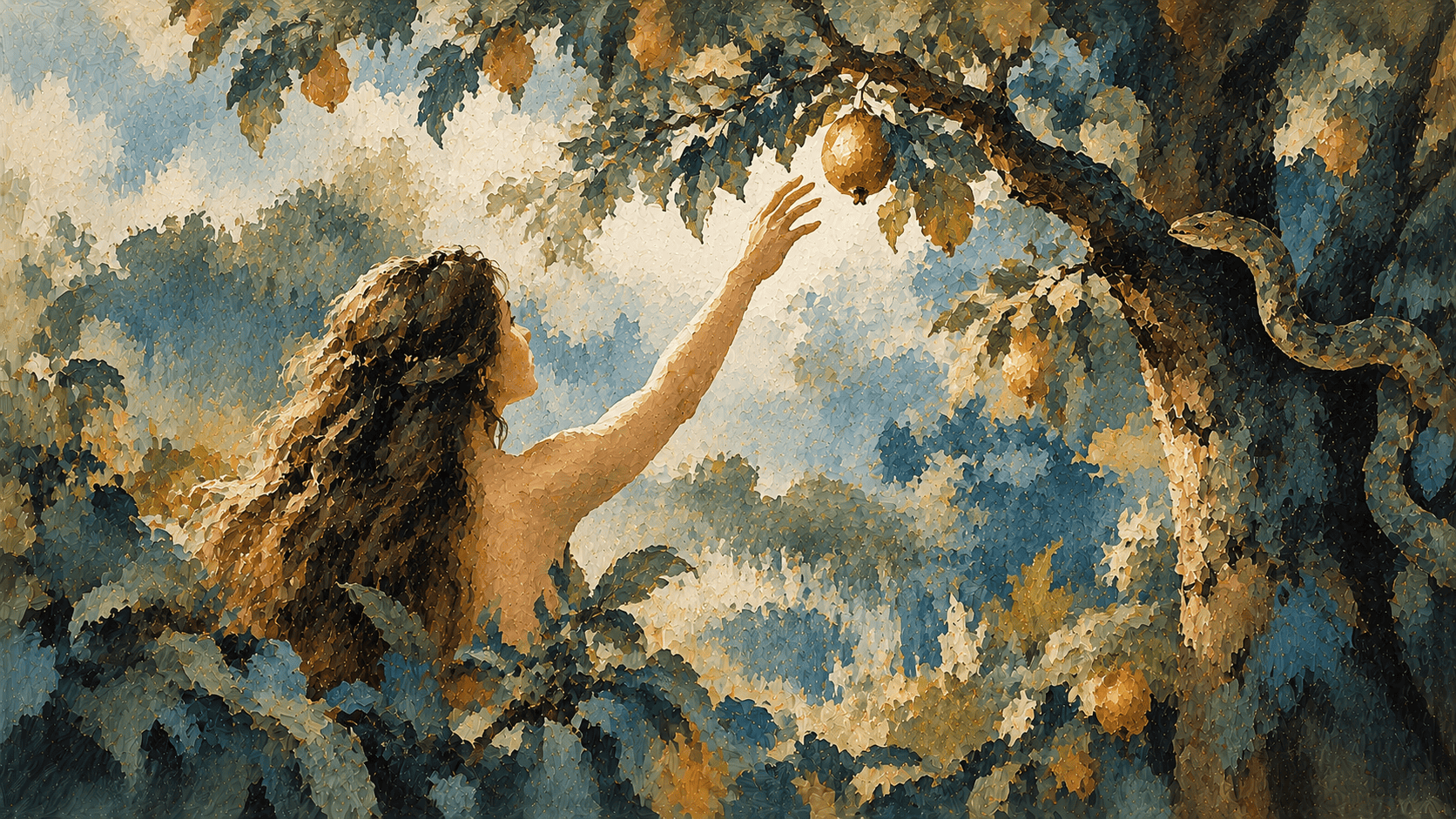
The Bride is established in moral perfection (Rev. 19-22). But is that any different from what Adam and Eve started out as? They were morally perfect too, until they ate that blasted apple (I know it wasn’t an apple, chill people).
In one sense that is correct. Before the Fall, Adam and Eve were morally upright in the sense an infant is morally upright. They were innocent of any wrong. God called creation, after their inclusion in it, to be “very good” (Gen. 1:31). If they hadn’t fallen, they would still be in paradise.
But that stupid (ingenious, really) serpent came along and ruined everything.
Well…I beg to differ. We are assuming if Adam and Eve hadn’t eaten the forbidden fruit, they would never have experienced suffering. And I have to say, I’m not sure what biblical evidence there is for that assumption. Scripture never establishes that innocence made Adam and Eve incapable of suffering.
Instead, I’m going to suggest Adam and Eve were in a position that left them vulnerable to both unintentional causes of suffering and sinful causes of suffering. We know the latter is true because they ate the not-an-apple. But what’s this unintentional stuff?
I’m not claiming the following actually happened in Eden. I’m using these examples to test whether innocence, by itself, would have made suffering logically impossible.
Because Adam and Eve were in a state of ignorance, they were vulnerable to accidental suffering. Adam is walking through the woods, he bumps past Eve because he doesn’t yet know the concept of personal space, Eve stumbles into a tree, trips over a tree root and breaks her leg. That’s unintentional suffering caused by ignorance.
Now let’s say, before the Fall, Adam is walking through the woods, sees Eve, she’s in his way, he intentionally shoves her aside because he doesn’t yet know how unloving that is, Eve stumbles and breaks her leg. That’s intentional suffering caused by ignorance.
Both of those scenarios are possible well before they started studying their forbidden tree. Just because such a scenario did not occur before the Fall, doesn’t mean such a scenario couldn’t occur. I don’t need to prove it would have; I just need to establish it’s a logically coherent possibility.
Our sinful capacity preceded eating the forbidden fruit. Adam and Eve were already eyeballing that tree when the serpent started talking, and he tempted them out of the desire of their own hearts (Jas. 1:14-15). Eve was simply too ignorant to know better (1 Tim. 2:14). So she ate. However, the Fall did not occur until Adam ate (Rom. 5:1-14). Sin preceded the Fall. Eve ate and became a sinner (1 Tim. 2:14). Adam ate and mankind Fell.
Most modern theology frames the naked and not ashamed thing as good. But there’s zero biblical evidence for that assumption. Biblically, nakedness is repeatedly associated with shame rather than righteousness. Wearing clothes, however, receives a different treatment.
From Gen. 3:12 forward, clothing, especially white linen, is used as a metaphor of being dressed in righteousness (cf. Is. 61:10; Zech. 3:3-5; Gal. 3:27). In Revelation 3:17-18, Jesus rebukes the Church of Laodicea for a fascinating reason:
“You say, ‘I am rich; I have acquired wealth and do not need a thing.’ But you do not realize that you are wretched, pitiful, poor, blind and naked. I counsel you to buy from me gold refined in the fire, so you can become rich; and white clothes to wear, so you can cover your shameful nakedness; and salve to put on your eyes, so you can see.”
Emphasis mine.
The Difference in the Bride
The Bride is a very different story:
Let us rejoice and be glad
and give him glory!
For the wedding of the Lamb has come,
and his bride has made herself ready.
Fine linen, bright and clean,
was given her to wear.”
(Fine linen stands for the righteous acts of God’s holy people.)—Revelation 19:7-8
The Bride is clothed in fine linen representing her own righteous acts. And before you raise a finger in the air, I know the Church is clothed in Christ’s righteousness (Gal. 3:27; Rev. 7:9-14). But the Church is not yet the Bride. She is the betrothed (2 Cor. 11:2). The Bride is at her wedding, wearing her own righteousness. She has been transformed by the work of the Holy Spirit. So it breaks down like this:
- Mankind starts out naked and unashamed.
- Mankind Falls.
- Mankind is naked and ashamed.
- God makes them clothes.
- Clothing becomes symbolic of God’s righteousness.
- The Church is clothed in Christ’s righteousness while the Holy Spirit transforms her.
- The Bride is clothed in her own righteousness.
The difference between Adam and the Bride is this: Adam was naked, not ashamed, and vulnerable to suffering and sin. The Bride is clothed in her righteous acts and not vulnerable to suffering and sin.
What happens in between Adam and the Bride? An entire history of mankind’s exploration of sin, love and the consequences of both.
So when we ask why can’t God make mankind perfect from the beginning, we are asking God to cut out the beginning and historical middle, and go straight to the Bride.
Why Is the Bride Different?
We have established the Bride is clothed in her own righteousness. What about that is impossible to recreate out of the box? Let’s think about what it means for the Bride to be righteous. It means she is perfected in the fruit of the Spirit which is “love, joy, peace, forbearance, kindness, goodness, faithfulness, gentleness and self-control. Against such things there is no law” (Gal. 5:22-23). Why is there no law? Because “love is the fulfillment of the law” (Rom. 13:10).
In other words, the Bride is perfected in love. Her character is love. But I believe there is a step that leads to love that we don’t usually talk about. Wisdom.
I believe love is the glue that unifies the Bride, but wisdom is the source of that glue.
Wisdom is the capacity to correctly interpret reality and discern the fitting course of action.
The “and” is intentionally doing a lot of work. Wisdom is knowledge capable of being applied correctly.
I’m going to make two assumptions I believe are biblical:
- Wisdom is to be prized and sought after (Prov. 3:13-15; Eccl. 7:11-12).
- Ignorance is the pre-existing condition from which wisdom develops.
#2 may be confusing so let me explain; is it possible to be born wise? No (Cf. Deut. 1:39; Prov. 22:15). We are formed in the womb from a state of ignorance. We slowly gain knowledge as our senses develop and with experiences after birth. If we gain appropriate knowledge, we will recognize the value of wisdom and seek after it.
Because ignorance is the starting point of human consciousness, human consciousness cannot come pre-programmed with wisdom because wisdom requires experience with what it means to be wise. Wisdom requires a history in which one learns wisdom. Even Christ is biblically represented as a perfect human who still needed to grow into a state of wisdom and perfected obedience (Lk. 2:52; Heb. 5:8). If anyone could come pre-programmed with wisdom, it would be Christ, yet He still began in a state of ignorance from the womb.
And someone may ask, well doesn’t that show perfection could be done out of the box? Wisdom or no wisdom. I’m going to go out on a limb here and say Christ was not born perfected. He was sinless, learned obedience through suffering, and then was perfected. In other words, He was born innocent and ignorant, and grew in wisdom—all while never once committing sin. That doesn’t mean He wasn’t vulnerable to suffering. The Bible establishes quite the opposite.
Objection: That’s because humanity was already in a fallen state.
But again, I’m arguing unintentional accidents in pre-Fall mankind were logically possible. Jesus could have been born in Eden, surrounded by a lot of other innocent Edenites, and still be vulnerable to unintentional suffering. Adam could bump into Jesus as easily as he could bump into Eve.
I am arguing, Beloved, that Jesus still experienced ignorance even though He was morally perfect. Ignorance, in and of itself, is not sin.
Objection: Jesus was omniscient—all knowing.
Nope. He was not, and He admitted it Himself, “But about that day or hour no one knows, not even the angels in heaven, nor the Son, but only the Father” (Mk. 13:32).
So you see, even Jesus was born without perfected wisdom.
You Can’t Take the History Out of Wisdom
I would challenge you to look at wisdom scriptures in the Bible. It is interesting that wisdom is intricately tied to action (Jas. 3:13; Matt. 7:24; Prov. 8:32-36). I would argue inseparably tied to action. I’m not saying wisdom is action. I’m saying wisdom is the capacity to correctly interpret reality and discern the fitting course of action.
Let’s look at what wisdom would be without action. The correct interpretation of knowledge…that just sits there and wisely…never gets applied to anything. Now, that is hypothetically possible. I’ll grant that. However, can we really say a person is living wisely if correct understanding never shapes what they do? I don’t think we can.
Faith without works is dead (Jas. 2:17), and love that remains only in words is insufficient (1 Jn. 3:18). Scripture makes a similar connection with wisdom: “Let them show it by their good life, by deeds done in the humility that comes from wisdom” (Jas. 3:13). Action does not create wisdom, but it is the natural expression of wisdom. Correct understanding that never affects how we live has failed to do what wisdom is supposed to do.
Therefore, if wisdom is inseparably tied to action, then action requires something real upon which to act. If action genuinely occurs, then a history has formed. Therefore, wisdom requires a history through which it can develop.
Ultimately, I’m arguing you can’t take the history out of wisdom and still end up with wisdom. Which means if the Bride is to be wise, she needs a history that establishes what wisdom knows to act on. Such a history involves the possibility for mistakes to be made and consequences to occur. That does not mean harmful consequences have to occur. It means they have to be possible. If our actions are genuine, then their consequences must be genuine too. Otherwise, God has not removed our ability to choose wrongly; He made it impossible for our choices to produce the consequences they would otherwise produce.
Therefore, I believe the idea of created wisdom without a history of ignorance and experience is a logical impossibility.
The Problem of Ignorance
I have a theory I call the “problem of ignorance.” Ignorance is the lack of knowledge or misapprehension of knowledge. The problem of ignorance is it allows for a person to fail to correctly evaluate something as good or evil, or to reason from a place of distorted understanding. Because of this incorrect evaluation or distorted understanding, an individual may choose to sin. Once sin enters the picture, a person may resist correction, suppress truth, or deepen the very ignorance that helped produce the disorder in the first place.
In other words, the problem of ignorance is when we do not understand something correctly, we may judge it wrongly. That wrong judgment can lead us to choose sin. Once we sin, we may become even less willing or able to see the truth clearly.
The theory argues that while ignorance is not automatically sin, ignorance is at the root of the sin that does occur (1 Cor. 2:8; Eph. 4:18-19; Hos. 4:6). Some say pride is the root of sin, or the love of money is the root of sin. But sinful pride is a lack of knowledge of who you truly are. And the sinful love of money is the lack of knowledge that money cannot be our idol.
So while Adam and Eve were created innocent, they were also ignorant. Their ignorance left them vulnerable to both accidental suffering and sin, as we previously discussed.
In the Bride, that exact vulnerability disappeared. Why? Because she obtained wisdom. Remember, wisdom is the capacity to correctly interpret reality and discern the fitting course of action. Wisdom is the solution to the vulnerability left by ignorance.
This is why the biblical story unfolded as it did:
- Mankind starts out innocent and ignorant.
- Mankind ignorantly sins and obtains knowledge of good and evil.
- Mankind continues to sin but also begins to gain wisdom (Gen. 4:26; 5:22).
- Jesus dies for the sins of mankind.
- God’s children are clothed in Christ’s righteousness (Gal. 3:27; Is. 61:10).
- The Spirit of Wisdom is poured out on God’s children (Is. 11:2; Eph. 1:17).
- The Spirit begins to transform God’s children from fleshly works to spiritual fruit as they grow in wisdom (Gal. 5:16-25; Phil. 2:13).
- At the end of the age, the Bride is sufficiently wise that she is clothed in her own righteous works (Rev. 19:8) and the Spirit of Wisdom is still with her (Rev. 22:17; Eph. 4:30).
There’s a process that transitions ignorance to wisdom. That’s the history I was talking about earlier. Mankind remains vulnerable to sin until the day the Spirit sufficiently matured the Bride so that she can walk in her own wisdom-empowered good works.
So Why Couldn’t God Create Humanity Already Perfected?
A Bride without a history is not wise. Without the history and the transforming work of God acting within that history, she would be exactly as Adam and Eve were—ignorant and thus vulnerable to sin.
But in the biblical plan, God creates mankind beginning in ignorance, which allows for sinful consequences. Sinful choices have consequences, and those consequences bring suffering. Sin and suffering run so rampant that even God wants a reset button (Gen. 6:6; Ex. 32:9-10). Instead of eradicating humanity completely, He enters history Himself and dies for the sin of mankind. This opens the door for the problem of ignorance to be solved. The Spirit of Wisdom is given and ultimately, the Bride reigns with Christ in full wisdom and freedom from sin. This history allows God to maintain free will and still deliver His children from suffering and sin.
There is no shortcut key here. If there was, I’m pretty sure God would have used it when they made the golden calf and He was ready to destroy His entire nation.
Think about it.
This history requires God to go to the Cross Himself.
If it was possible for God to shortcut history and cut straight to wisdom, don’t you think He would have done it at least when Jesus was on his face, sweating blood and hoping for a way out? Jesus was in severe distress. Matthew 26:39 accounts for Jesus praying, “My Father, if it is possible, may this cup be taken from me. Yet not as I will, but as you will.”
I used to believe the Father didn’t answer this prayer because it was His plan for Jesus to go to Calvary. Period. But now I think the key part of Christ’s prayer is “if it is possible.” I believe the cup was not removed because it was not possible to remove the cup and provide Christ the joy set before Him (Heb. 12:2). I happen to believe that “joy” is eternity with His Bride.
The Father considered redemption of the Bride worth the death of His Son (Jn. 3:16). If God could have given the Son the Bride without scars on anybody’s hands, I think it logical He would have.
We often fault God for the suffering we experience and ask why He didn’t allow that cup to pass. Yet, we don’t often remember; God didn’t allow Christ’s cup to pass either. This isn’t God on a joyride. God isn’t following a pre-established plan that is too late to shake off now.
A wise Bride needed a history that allowed for suffering. It’s not that God wanted suffering. God wanted a wise Bride for the Son. His end goal is unity of all creation under Christ (Eph. 1:9-10).
No Father allows their Son to be tortured and killed because He’s too lazy to think of an alternative. I think we need to give the Creator a bit more credit than we often do. God did not remain outside the suffering this history allowed. We need to think about that before we find fault in His logic.
Does That Mean Evil Was Necessary?
No. Period. End of story. A history that allows for consequences does not require evil to exist. It allows for evil to exist. There is a difference, and that difference matters.
I am not claiming God needed rape, murder, abuse, betrayal and mass genocide. I am claiming God desires Christ’s Bride to spend eternity free of suffering and sin. In order to achieve that, the Bride must be wise. And wisdom requires a genuine history involving genuinely free, initially ignorant creatures permit genuine actions and genuine consequences.
Our lives are but a drop in the ocean of eternity, Beloved.
God does not need our suffering. But if He wants us free of eternal suffering, it makes sense He is willing to allow us to suffer now. Just don’t forget He did more than watch.
All Scripture quotations are from the New International Version (NIV).